


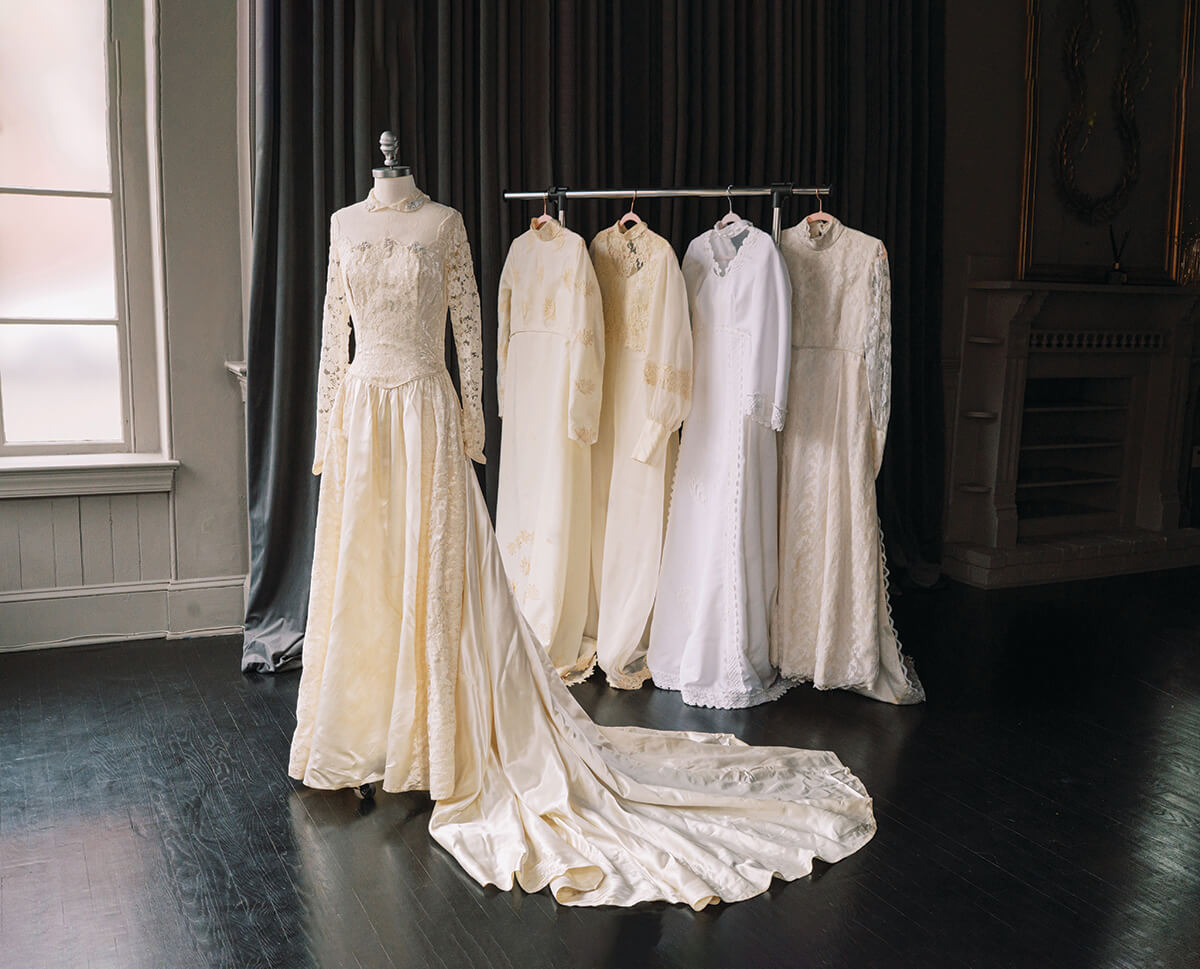
Above: Five of the estimated 40 wedding dresses that Mary Einolf made, including for her daughter, granddaughters, and several women who married into the family. These dresses were made between 1953 and 1978.
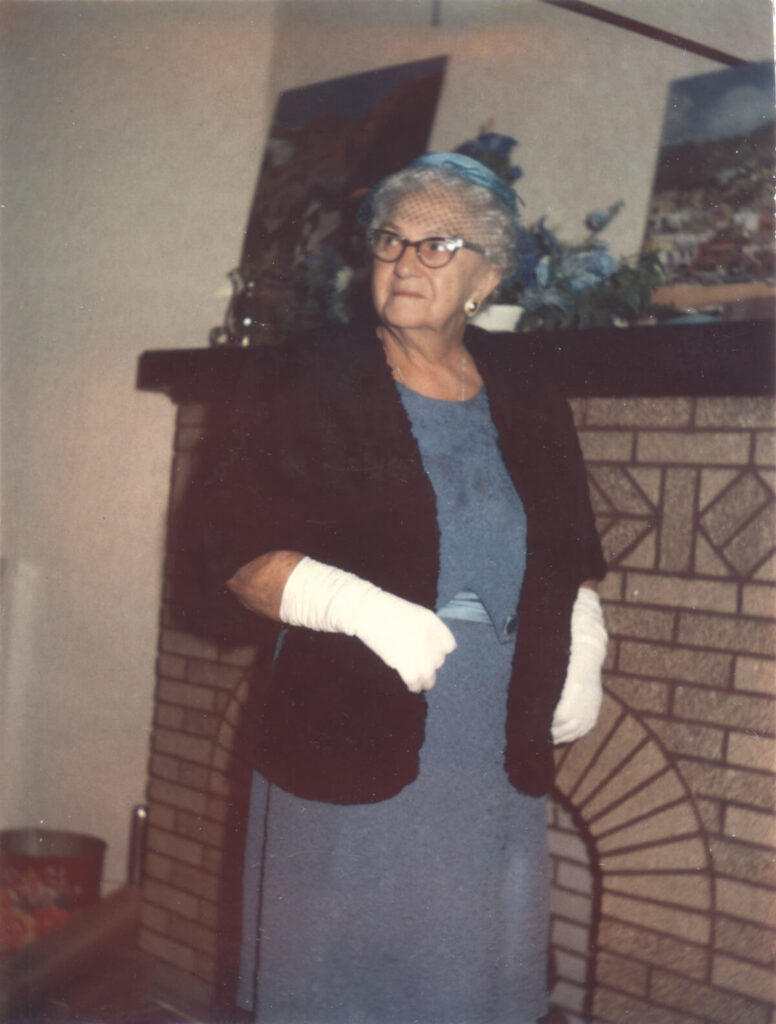
Eleven years after his mom died, Nick Schauman, the beloved owner of The Local Oyster, walked into Jill Andrews’ Hampden studio and handed over her wedding dress. The dress had been passed on to him when his father was cleaning out his attic and then lived for years in Schauman’s basement. He didn’t want to randomly donate the dress and so finally he searched “wedding dress designer” and found Andrews just a few blocks from his home.
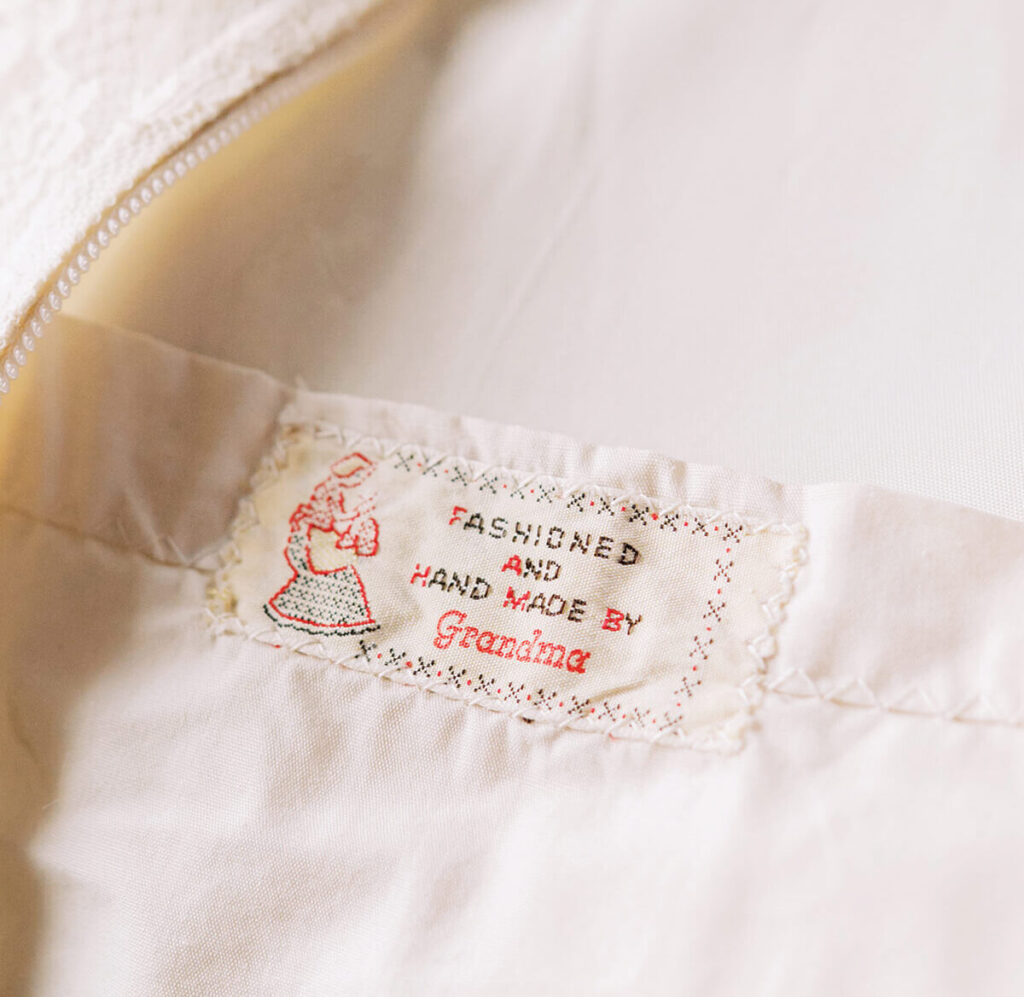
The custom dressmaker, who has a fondness for nostalgia and had recently lost her own mother, put it on a dress form and steamed it so Schauman could see how it had looked on his parents’ wedding day. It was tucked inside the dress that Andrews found a tag that read “Made By Grandma.” Up until that moment, Schauman had no idea that the dress was a family heirloom.
It turns out “grandma” was Mary Einolf—affectionately known as Grandma Einolf— Schauman’s great-grandma on his dad’s side. And her dressmaking practice extended well beyond the one she made for his mom, Marjorie “Marge” Schauman (her granddaughter-in-law). By best estimates, she made more than 40 wedding dresses for the women of the family, as well as friends and neighbors.
Discovering the provenance of the dress inspired Schauman to reach out to long lost family. (“I’m not even sure how I’m related to everyone,” Schauman had joked when emailing the group.) And so, on an overcast afternoon a few days before Thanksgiving, Schauman gathers with a small group of family members, including Nina Hochrein, 92, one of Einolf’s eight children. A single dress had created a ripple effect of family reunion and storytelling.
Einolf, who was born in 1895, grew up in Waverly Place on Gorsuch Avenue near Clifton Park. Her own mother used to make clothes for her, Hochrein tells the group, but she was “very particular, and didn’t like the fit, and her mother said, ‘Well, if you don’t like it, do it yourself!’ And that’s how my mother got to sewing.” She kept sewing, supplementing the family income by doing alterations for folks in the neighborhood and even making clothes for Rosa Ponselle, the opera singer. She would perch her transistor radio in the window to get good reception and listen to the Orioles games while she worked, often mixing with the ambient sounds from Memorial Stadium just down the road.
She loved sewing and was good at it, but didn’t start making wedding dresses until it came time for her own children.
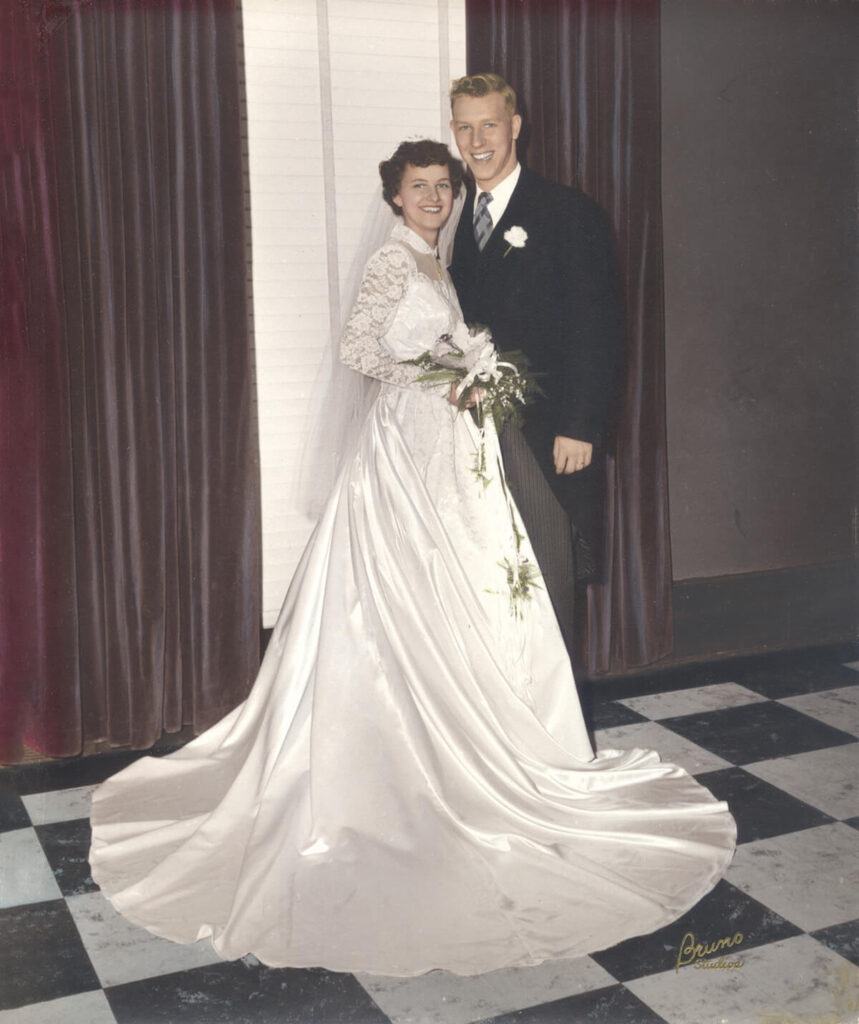
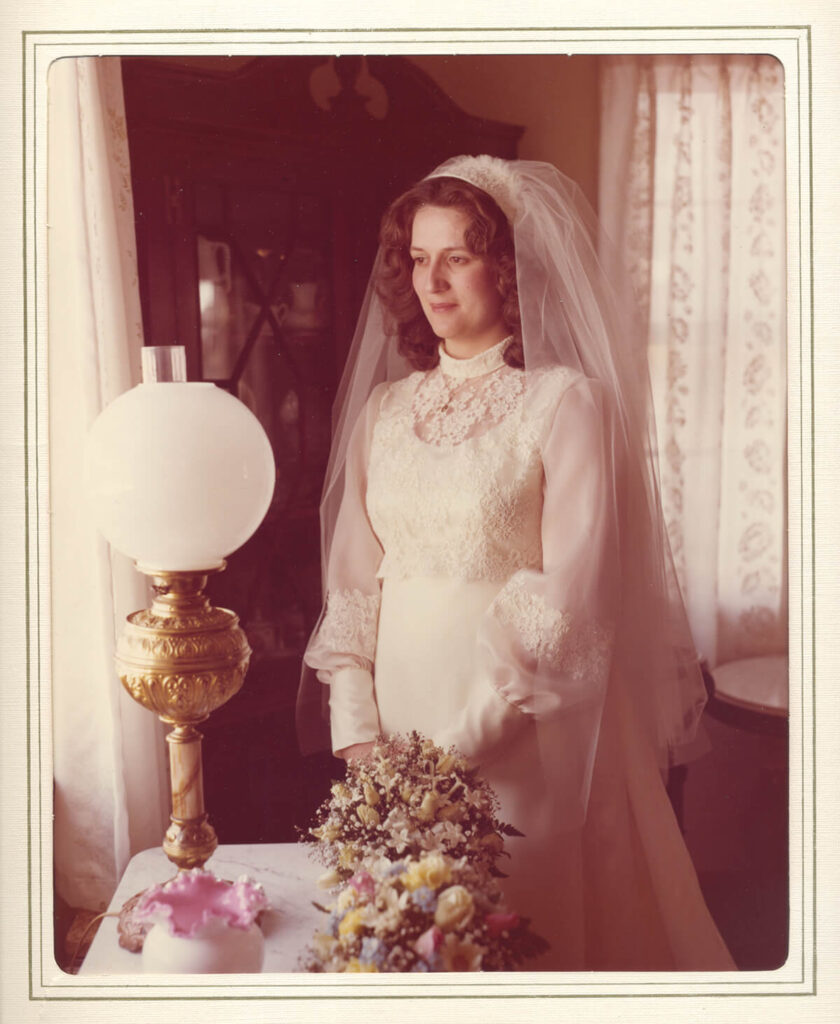
When Hochrein and her fiancé, Don, planned their wedding, it was January 1953, two months after their engagement and a month before they were to be married on Valentine’s Day—as quickly as possible in case Don was drafted, explains Hochrein. In barely four weeks, Einolf made a wedding dress, a “going away outfit,” and all the bridesmaid dresses in a crushed red velvet. It was out of love, but also, says Hochrein, out of necessity. “We were poor.” Even though her mom has been gone 40 years she still wells up talking about her. Hochrein’s older sisters might have had the first mom-made wedding dresses, she can’t remember, but hers, still lovingly held onto, felt exceedingly special.
“I told her exactly what I wanted,” says Hochrein. It was the year that Queen Elizabeth was crowned (her coronation took place four months after the wedding) and she wanted a regal headpiece. She also wanted some exposed skin—but under sheer netting of course. It was 1953, after all. With that, Hochrein reaches into the patterened hat box she had tucked away and pulls out the dress, proudly showing off the details—including the covered buttons lining each cuff that must have taken ages to create and embellishments around the collar and bodice. The dress—other than some netting torn with age and a few stains—is pristine. It has survived “70 years and four houses. That was no easy feat,” says Hochrein. It has also outlived her husband.
After that, the dresses just keep coming. Hochrein’s daughter, Elisa Lawson, remembers attending Schauman’s parents’ wedding in 1970. She was just a tween—wearing her confirmation dress made by Einolf—to the reception. “I remember your mom looked so elegant in this dress that grandma had made.” (This is one of many times that Schauman will get choked up.) Lawson remembers Einolf having a stack of labels by her sewing machine. “One of them said ‘Handmade by Mother,’ another one said, ‘Handmade by Grandma,’ and another said, ‘Handmade by Mary.’ And everything she made got that tag in it, depending on who you were to her.”
In fact, it was that tag that started all this. After Andrews found the tag, Schauman pressed his dad and it triggered a memory. “He said, ‘Oh, Grandma Einolf made that dress, and then she made everybody else’s dresses.’” Schauman immediately texted Andrews. “I was like, ‘Oh my God, you’re never going to believe this!’ And then we just went crazy.”
Now Schauman sits with Hochrein, Lawson (via Zoom), and Renee Webster, who married into the family via her husband, Kevin, who was also Einolf’s grandson. She and Lawson were married six months apart in 1978 and Einolf made both their wedding gowns, along with all of Lawson’s bridesmaid dresses and a suit for her brother, who was the ring bearer.
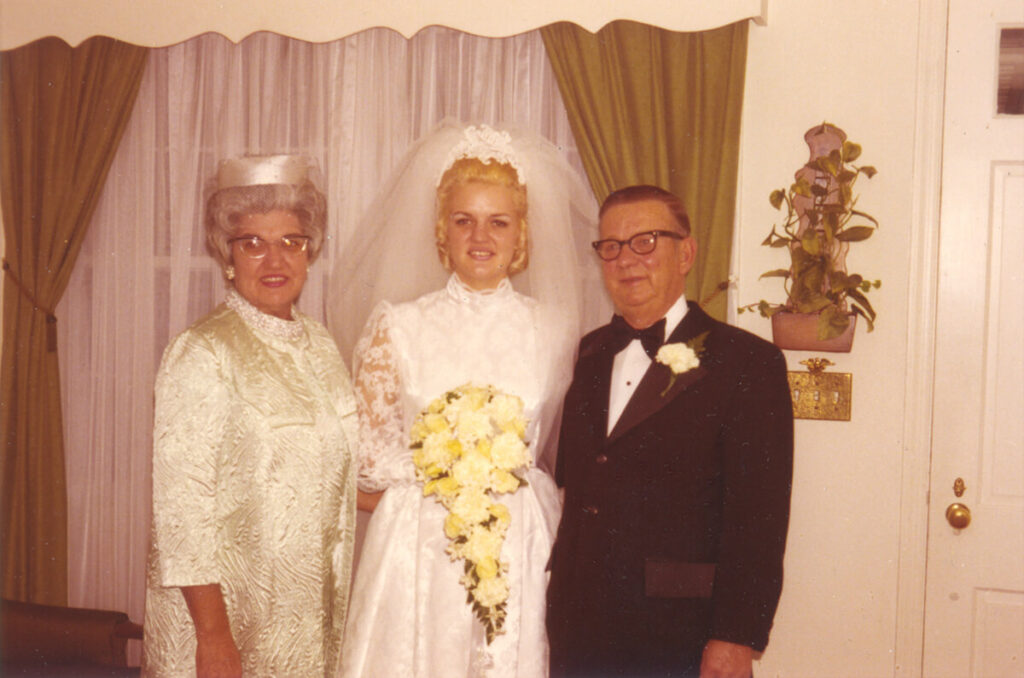
When Webster got engaged, she mentioned to her mom that Einolf had offered to sew her dress and immediately her mom insisted she accept. “What an honor,” she remembers her mother saying. Those words changed her entire feeling about the gift. For Lawson, however, it was always a given. “It’s just a different experience than what girls do nowadays when they [go into a bridal shop and] turn on those fancy lights, and everybody sits around and cries,” she says. “Everything was made by my grandmother. So, when it came time to get married, you didn’t even think that going somewhere to get a dress was an option, because she made everything you’d ever worn.”
The first step was buying the materials. Webster and her mom went to Yardstick in Perry Hall and Lawson remembers shopping at Shocket’s on Eastern Avenue in Highlandtown for the fabric, lace, and zippers. “The lace had these really heavy flowerets on it, and she literally cut them all off the netting and hand sewed every one of them on the train of the dress.”
As they share their stories, Hochrein is nodding. “I remember my mother sitting on the floor with the dress and sewing it by hand,” she says. One image they all remember: Einolf was barely five feet tall and sometimes the dresses were twice her size.
“She’s making a dress for a size 14/16 girl, and she’s just this tiny little lady,” recalls Webster of her experience. “I’m like, “Oh, is she going to be able to do this?’ And of course, she did it with precision. It didn’t even phase her, you know.” Webster can’t quite remember how much the materials and pattern cost but “we never saved any money by doing it, because my mother said, let’s buy the best fabric, the best of lace,” she laughs.
Einolf had an organizational system that worked for her—each corner of her bedroom was a sewing project she was working on. “There was a pile of fabric that was either somebody’s wedding dress, bridal party, someone’s First Communion dress, or someone’s Easter coat,” says Lawson. “And when you came over for a fitting, she just went to that corner and pulled out whatever you were there for and then started working on that for a while. And then when the next person would show up, she’d go to the other corner and start working on that.” She was never just working on one project at a time. Lawson is still in awe of it. “It was just amazing that you could walk in a room, and she’d know what pile to go in to get your stuff so that you could stand on the stool and get fitted.”
When she passed away in May 1985, Einolf had well over 30 grandchildren. In one year alone seven new grandchildren were born. “People used to say to say, how many grandchildren do you have, Mary?” says Hochrein. “And she’d say, ‘When I went to bed last night, it was eight.’ My mother had a sense of humor.”
A few weeks later, five of Einolf’s dresses will be steamed and photographed together for the first time. It’s overwhelming to see them as a collective and you can’t help but appreciate the craftsmanship, varied styles, assorted fabrics, and techniques she used.
All the dresses are survivors, in one way or another, but Schauman’s mom’s most of all. A few months after he dropped it off, the “Castle” at Keswick, which houses Andrews’ studio, suffered a massive fire. Several of her dresses were ruined. But not Schauman’s. “Jill texted me and told me she saved mom’s dress,” he says. And so today, as Schauman poses with the dress, tears run down his face.
“She was such a sweet lady,” says Webster of Grandma Einolf. “Even as an in-law, she treated me the same as if I was one of her blood grandchildren.” She remembers her mother calling it an honor. But it’s meant even more as the years have passed, she says. “I don’t think I even realized how special it was until I got older.”